About Nyansa
-
National Shrine of Afrikans in America
-
Sankofa Processional Overview
-
The Ancestral Resting Place
-
Asuo Sankofa
The National Shrine of Afrikans in America (NSAA) was established by the Ankobea society’s Akradwarefo Asomfo (Ministry of Cultural Affairs) in 1990. NSAA was established to advance the general awareness and practice of traditional Afrikan spiritual systems, and thereby facilitate the spiritual grounding of the Afrikan centered and nationalist pan-Afrikan movement within the Afrikan community. The work of NSAA includes the development and maintenance of national ritual spaces, shrines and rituals. Those ritual spaces include sacred groves, gardens, streams and shrines. These areas have been consecrated and are regularly maintained. There is also a burial ground in which lie the remains of a number of our enslaved ancestors. Several national ancestors have been enshrined. They are Nat Turner, Harriet Tubman, The Honorable Marcus Mosiah Garvey, Sojourner Truth, Malcolm Omowale, Nana Ida B. Wells, Martin Luther King, Jr., Mary McCleod Bethune, Nana Yao Opare Dinizulu, Fannie Lou Hamer, Nana Otumfo Osei Tutu, Queen Mother Nana Yaa Asantewa, and Okomfo Kwasi Panyin.
A rural area was chosen for the site of NSAA because of the greater measure of independence that can be exercised here. These grounds are especially significant in that they are the site of a slave plantation, and date back to the late seventeenth century. This is also the site where an Afrikan warrior priest-healer was enslaved. Okomfo Kwasi, as he is known to us, was appointed by the Asantehene of his times to sojourn to the land of the whites as a slave in order to establish the clan of his healer-ancestors on this side of the water. It is he who has guided our efforts here. His work, however, was first sanctioned by a major deity of West Afrika, Asuo Gybei, who is acknowledged as our patron deity.
The orientation of NSAA is Pan-Afrikanist. We salute and give thanks, honor and praise to divinities and ancestors from areas throughout the continent and throughout Afrikan history. We have been blessed with the presence of divinities from the Akan, the Yoruba, Shona, Malinke, Haiti and ancient KMT. We have been honored with the messages of the enshrined ancestors, ancestral clans from areas throughout West Afrika, and ancestors of antiquity and from the period of our enslavement.
The major goals of NSAA include:
- To facilitate a national and pan-Afrikan communion and collective celebration of the deities and ancestors of the Afrikan nation/world.
- To facilitate and enhance the spiritual cohesiveness of the Afrikan community within the context of both human fulfillment and the ideology of nationbuilding/Sankofa.
- To provide a national institutional framework for the development, maintenance and expansion of traditional spiritual systems in America.
- To develop general standards and procedures for priests and institutions in the areas of spiritual training and education, codes of ethics, formal protocol, institutional aid and development, private and public rituals, public relations, research, and others.
The Sankofa Processional of Remembrance and Reaffirmation will begin in front of Thomas Morris Hall at the staff of the Akan divinity, Nana Sankofa. The staff is topped by Sankofa’s symbol, and graced by the red, black and green national banner. The staff and the divinity, Sankofa, stand at the center of this national effort to reclaim and reconnect with our traditions. Thomas Morris Hall was often referred to by a former owner as the “old massa’s house.” The homestead (the main house and the twin oaks) has been traced back to the late 1600’s. The house in recent times has served as house and headquarters for Heritage Village Encampment, a summer camp sponsored by NationHouse/Sankofa Fie (Wash. D.C.), the Ankobea Leadership Training Retreat, and other Ankobea and NationHouse activities. It is currently being transformed into a shrine and resource center.
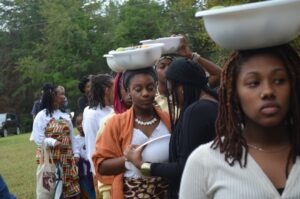
The Sankofa Processional begins with a drum call by the drummers of Ankobea, calling all participants of the Nyansa Festival to gather at the flagpole. Other drummers are invited to participate after the initial call has been given by the society drummers. After the drum call a libation is poured, followed by comments and general directions provided by the Akyemfohene and Akradwarefohene (Ankobea ministers of Education and Cultural Affairs). We are instructed to organize ourselves in the order of the processional, which is as follows:
- Invocation bell
- Flag bearer and horn
- Ankobeahene and Ankobeahema
- Shrine, shrine bearers, present deities
- Akomfo, abosomfo, adunsinfo, abrafo
- Special guests
- Stool bearers
- Ankobea Adehye Nnwa (Ministers of Ankobea)
- Members of Ankobea
- Guests and friends
- Asafo (Security)
- Motor transport for elders and disabled
Once the processional has been arranged, the collective begins moving downhill toward the Ancestral Resting Place.
The Ancestral Resting Place contains over sixty marked and unmarked grave sites of enslaved Afrikans, many dating from the time of Afrikan enslavement. Okomfo Kwasi Panyin is buried there. The graves of the slaveholder’s family are located in a remote corner of the Resting Place. There has been a good measure of spiritual irresolution in this area due to the extreme trauma of the enslavement experience. Our rituals are intended in part to placate and heal those spirits. A fire burns for the duration of the Nyansa Odwira Weekend and the processional will circle the fire with the men on one side, and the women on the other. Libations are offered here; comments and song will be followed by a passing review of the Resting Place. Each marked grave is identified by a white pole which has been placed near the grave stone at the head of each grave.
Because of the unresolved nature of many of the spirits in the Resting Place, women who are with child or whose children are very young (up to two) are asked to avoid direct involvement in the ritual at the Resting Place. Please: 1.) distance yourselves from the collective fire and stand on the periphery; and 2.) use the alternate route around the Resting Place. Both will be indicated by the security personnel. Additionally, for all persons, many spiritual systems require guests and members to conceal all spiritual beads near a gravesite.
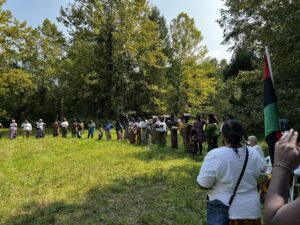
In the tradition of our ancestors from times immemorial, we march in song in a spiraling path down to the cleansing waters of Asuo Sankofa - the creek on the property claimed by the deity, Nana Sankofa. We again form a circle of men and women making up the two halves respectively. Instructions on the ritual bath of cleansing and renewal, which is available to all members of the processional, are given by Ankobea ministers. Members of the processional are asked to discard any trash and debris in the containers provided and use the latrine facility before crossing the bridge, as there are no trash receptacles or toileting facilities on the shrine hill. The men and the women proceed for their baths in separate yet parallel lines. When crossing the bridge to the National Shrine, each member of the processional is asked to salute the divinities of the water.
At Asuo Sankofa women on their cycle should salute Nana Sankofa and Okomfo Kwasi Panyin and request that passage be without adverse consequence. (Traditionally, women on their menstrual cycles did not cross waters.) Before crossing the bridge and while on the shrine hill they should cover their heads.